
Paper Published in Estuaries and Coasts Shows How River Herring Help Connect and Support Ecosystems
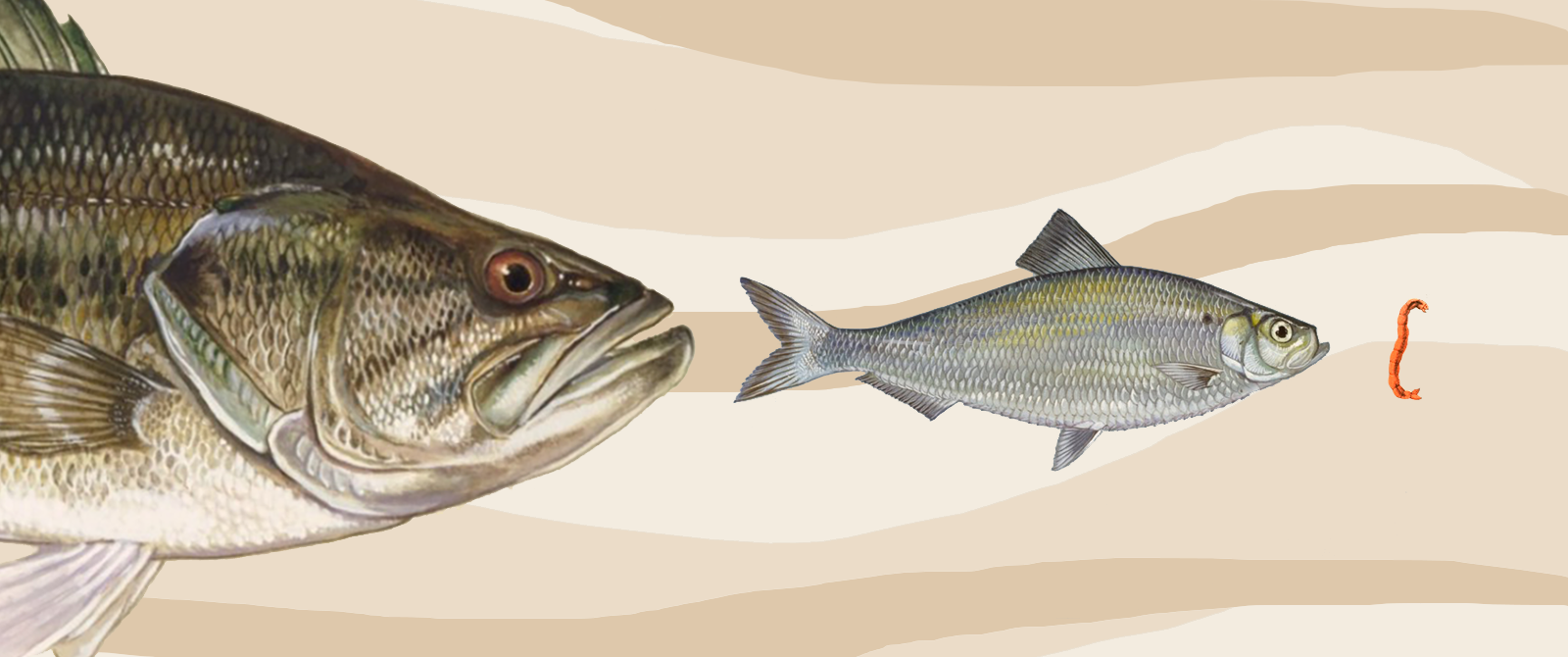
Nutrient Transfer Dynamics of Anadromous Alewives (Alosa pseudoharengus) in Freshwater Spawning and Nursery Habitats
As anadromous fish, river herring bridge two worlds: they hatch in freshwater, migrate to the ocean, and then return to freshwater rivers to spawn. Collaborators from MIT Sea Grant, Massachusetts fisheries and wildlife agencies, and the University of Waterloo investigated how migratory river herring, alewives, transfer nutrients between marine and freshwater ecosystems during spawning migrations in Massachusetts waters.
The paper, “Nutrient Transfer Dynamics of Anadromous Alewives (Alosa pseudoharengus) in Freshwater Spawning and Nursery Habitats”, was published this January in Estuaries and Coasts. The authors, Robert Vincent (MIT Sea Grant), John Logan and John Sheppard (Massachusetts Division of Marine Fisheries), Michael Power (University of Waterloo), Stephen Hurley (Massachusetts Division of Fisheries and Wildlife), and Kevin Bennett (MIT Sea Grant intern), focused on three ponds in southeastern Massachusetts.
Through a combination of field sampling, laboratory processing, and data analysis, the researchers assessed potential nutrient transfer by examining chemical “signatures” in the fish using stable isotope analysis. They measured carbon, nitrogen, and sulfur in adult and juvenile alewives, baseline food web components (plants and small animals), and freshwater fish that prey on alewives, including white perch, smallmouth bass, and largemouth bass.
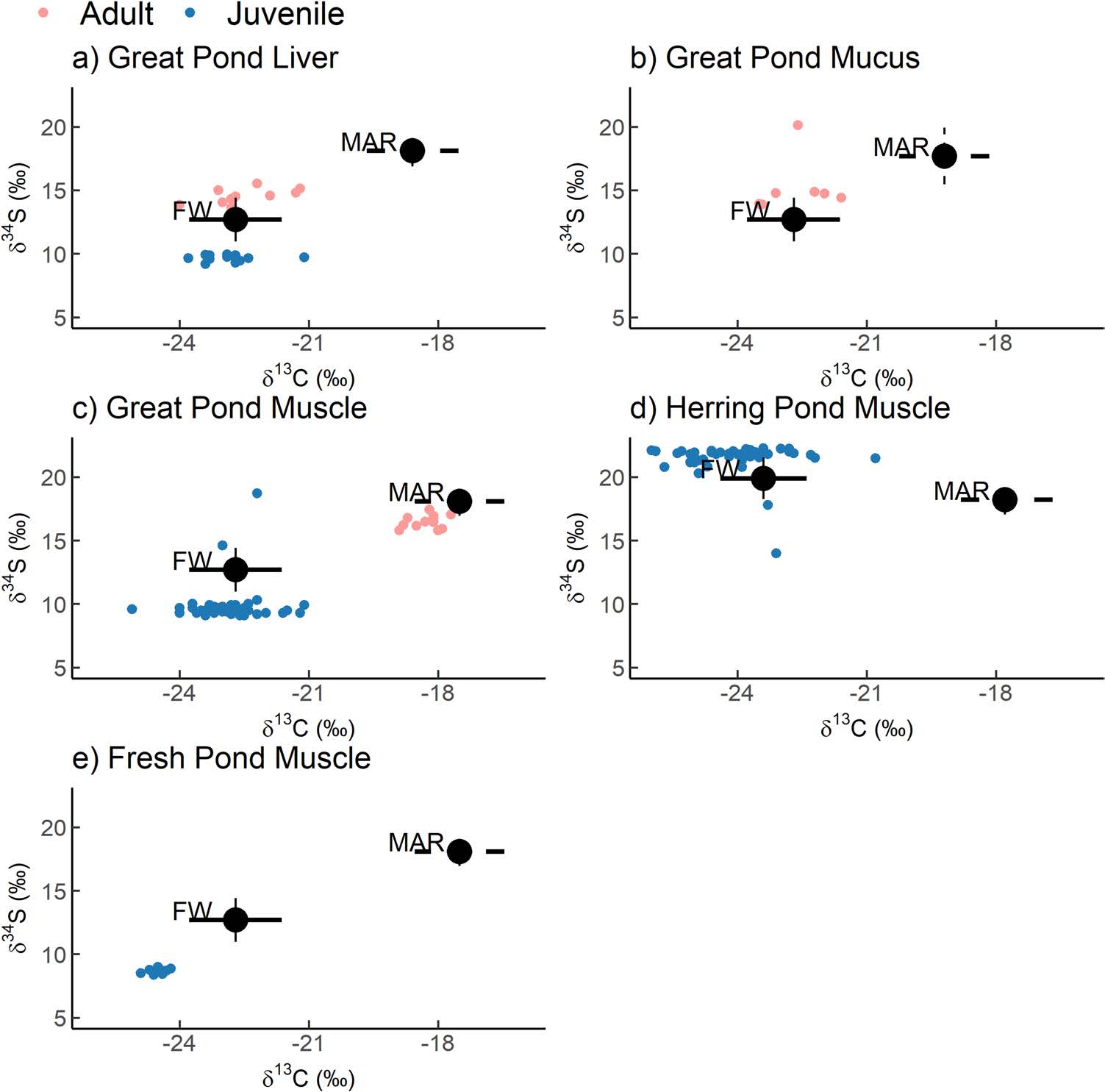 Carbon and sulfur isotope signatures measured in adult (pink) and juvenile (blue) alewife. The chemical signatures help indicate whether fish nutrients came from freshwater or marine sources. Values are shown for different tissues: (a) liver, (b) mucus, (c-d) muscle.
By comparing results across multiple tissue types, the researchers were able to analyze short and long-term diets and demonstrated that fish mucus can be used as a non-lethal sampling method. Samples were collected from two ponds in Eastham that have established alewife runs (Great Pond and Herring Pond) and a third pond in Plymouth (Fresh Pond) that underwent restoration during the sampling period to reestablish anadromous fish passage.
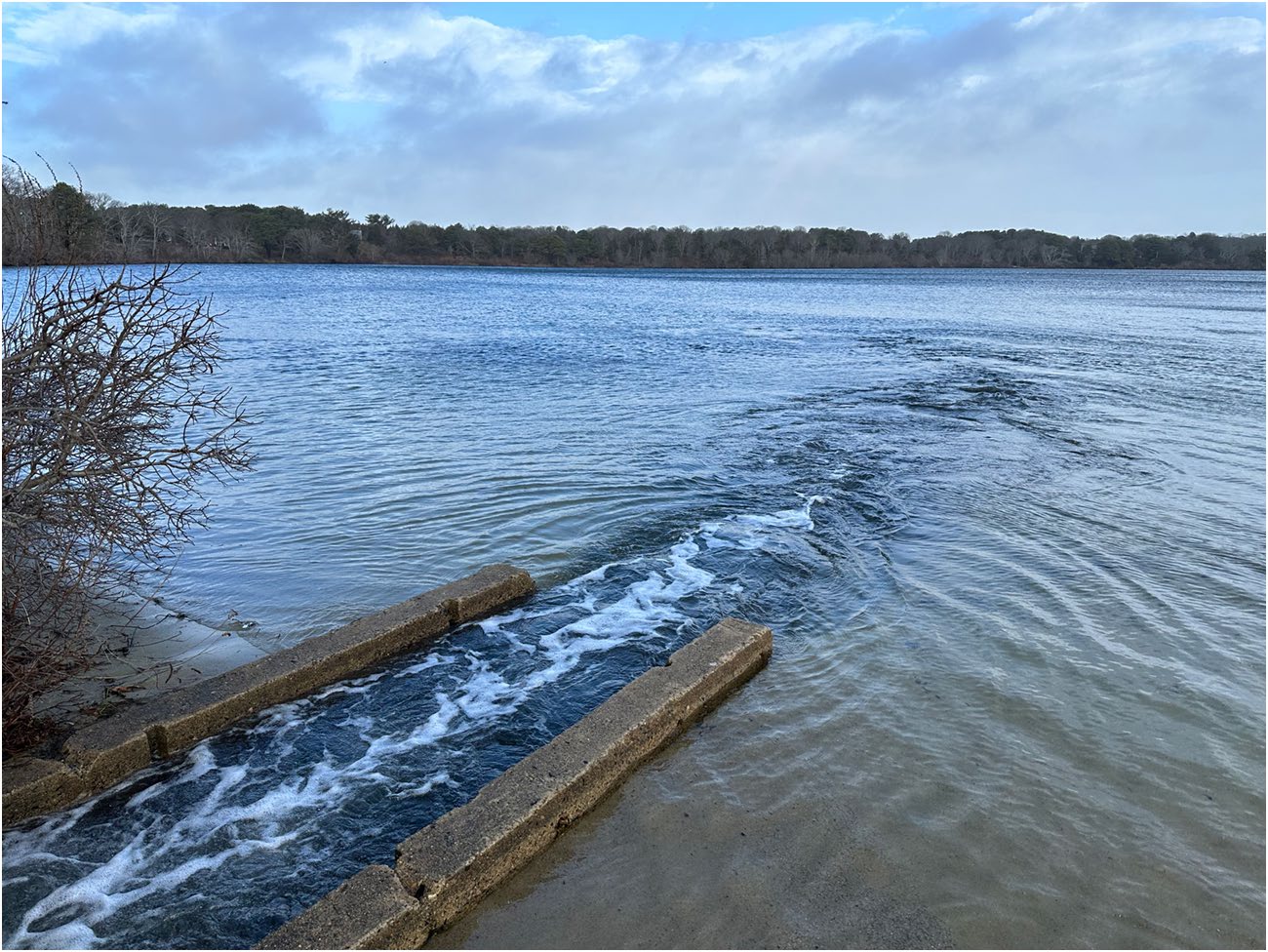 Marine salt water intrusion into Herring Pond in Eastham, MA during high spring tides (Image: Robert Vincent, 2021)
The study showed that restoring fish passage and supporting alewife runs provides clear ecosystem benefits, even with relatively small populations. Juvenile alewives were found to transport freshwater nutrients when they migrate back to the ocean, while adult alewives bring marine-derived nutrients into freshwater ecosystems when they return to spawn. By moving nutrients and energy between marine and freshwater systems, alewives connect and support food webs in marine and freshwater systems, and strengthen marine commercial and freshwater recreational fisheries.
The work provides valuable insight for fisheries and resource management planning, as well as for the conservation of alewife populations and the habitats and resources they depend on. Additionally, the results demonstrate the ecological, economic, and cultural benefits of habitat restoration and maintaining ecosystem connectivity through fish passage improvements.
This work was funded in part by the Massachusetts Bays National Estuary Partnership (EPA #CE96173901).